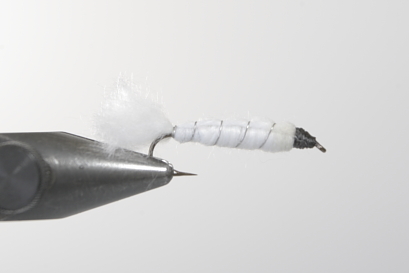
This fly originated in the very early 1970s and was attributed to a Brian Kench. It differs from earlier more traditional patterns in as much that there were no moving parts. Despite this it quickly found favour with the fly fishers of the day on the reservoirs and still waters, thanks mainly to the publicity given to it by Bob Church.
At that time I was tying flies for three of the local tackle shops and I was inundated with orders for the original baby doll and the several variants it had ‘spawned’. Fortunately Jean, my lovely wife, took it upon herself to deal with all the ‘baby doll orders’ and left me free to carry on tying proper flies.
It was only after a good day at Eyebrook reservoir that I appreciated how good a fly it was. Despite its success over the years it has fallen out of favour and given way to more exotic creations when more man made materials became available to fly tyers.
I would suggest that before you tie this fly you make sure your hands are clean. The baby wool is fluoescent and loses its appeal if it is grubby. I would also suggest that you scrap the fly after a days fishing, after all it is cheap as chips to make.
If you want to give your ‘doll’ a ghostly look gently stroke the wool body with an emery board to raise the fibres, but make sure that the head is well varnished and dry first.
Materials
- Hook – Long shank or Streamer hook ‘8’ and ’10’.
- Thread – Black or Red.
- Body/Tail – White ‘Baby Wool’.
- Rib – Silver wire (strong).
Good Luck and Happy Fishing.
Dave Cammiss and the Team
{ 20 comments… read them below or add one }
Next Comments →
HI!
I am writing from Hungary, and I just would like to say that these videos had made me sure that I’m going to start fly fishing.
So thank you!
Hi Joe
Thanks for your comments. Good to know that we have been able to help.
I will need to have words with Jon about giving you the e-mail address without it ‘going public’. If you let me have yours I will certainly respond.
Regards
DaveC.and the Team
Hello Mr. Cammiss,
I came upon your series of instructional videos a couple of months ago and I must tell you that because of them my tying has improved quite significantly. Thank you!
I would like to ask permission to contact you directly via email to ask some questions. If this is permissible please respond to the I entered when writing this comment.
Thank you for your time and the lessons,
Best Regards,
Joe Mathis
Hi Nigel
Welcome aboard
Thanks for your comments. You will find that you get as much fun tying as fishing with your own flies. Hasten slowly and I am sure it will all fall into place. Do not be afraid to use materials at hand if you dont have those in the book. Nothing is laid down in tablets of stone and some of the best flies were the result of just using what was available at the time.
Happy fishing
DaveC.and the Team
Hi david just started fly tying ive been looking at youre videos and they are really well done.ime going to make as many as possible for next season and forget bought ones just to see how they go.thanks very much
Hi Paul
There will be more . One being editted and needs the write up. The site was the result of doing a demo to my local fly fishing club using the video camera and projector. Jon thought we should do a sample lesson on youtube. The response inspired us to go on from there. Once a month Jon gives up his day off and we have a session in the bunker. He then locks himself away in the small hours to do the editting. I usually see the finished product after you guys. We are debating on the idea of doing a DVD but there will be a lot of work needed to meet his standards and I am not getting any younger.
Thanks for your interest
Happy Fishing
DaveC.and the Team
I think its because I have been so interested in the whole site. Really am enjoying the classes, will any more be added soon.
Hi Paul
You had seen something which I was not aware of.
It seems when Jon was completing the details for Youtube it asked for a company name. He put in thr first thing that came in his head!
I dont think we will be making anybody quake in their shoes.
Hi Dave,
Thanks for the advice, will look forward to practising the patterns on the series. May I ask, why the name Emanuel House Productions?
Hi William
Thanks for your comments. There is nothing laid down in tablets of stone on how to tie flies. You are doing the right thing and picking up what you want to know from all available sources. All we are doing is lighting the fire. We have a lot of fun doing these clips, with my younger son enjoying being the BOSS, all I do is tie the fly. If you want a good mag. that will give you ideas try Fly Fishing and Fly Tying magazine. Some very good contributors but some to take with a pinch of salt.
Happy Fishing
DaveC. and the Team
hi Dave
I have had some lessons from Paul Buchanan. (great guy)
After the lessons I had a look at your lessons and got some different tips and tactiks
I have always been a great fan of being shown how to do, rather than looking at pictures in books, some books are ok but others are not so good but I found that your lessons are the way to go.
THANK YOU VERY MUCH.
William
Hi Paul
Thanks for your comments.
Whilst I do spend most of my fishing time with the fly rod I do enjoy my coarse fishing,particularly trotting for grayling. The fly tying is my number one pastime as I can retreat into my ‘bunker’ anytime to play with different ideas. The essentials to start tying are simple. A vice, a fine pointed pr of scissors, hackle pliers, and a bobbin holder for the tools. Tying thread in black, olive, orange and red. Fine wire in gold and silver. If you want copper just find some cable to strip. Cock and hen hackles in black and brown will be enough to get started. Different coloured wools you will be able to scrounge from the women in your life, orange and green are a good start. Cock pheasant tail feathers are useful. Make friends with some of the shooters for teal, mallard or widgeon feathers, rabbit and hare skins. Once you start collecting it is addictive as you walk the river banks. Hooks in wet fly sizes 10 and 12 are a good start.
Try http://www.mikestackleshop.com for some of the above. or http://www.fishtec.co.uk.
I have no vested interst in either but use them both.
Hope this helps
Dave C. and the Team
Hi David,
Fantastic. I have only just begun fly fishing after 12 years of course fishing, basically thought it was to difficult, and the tying of flies was just out of the question. Since watching your series I have decided to take up this challenge, but before I purchase alot of ‘gimicks and gadets’, could you please advise me; what is required as standard tools, understanding that the materials such as feathers and the like depend on the fly to be tied.
Kind regards,
Paul.
Very nice fly! and looks very easy to ty, I will ty a few of those maybe tomorrow!
Regards.
Hi Will
Thanks for your comments . Practice makes perfect. O dont do many dry flies these days. Will try to fit the BWO. in some time. In the meanwhile I will give you the dressing.
Hook size 10…..16
Thread Olive
Tail Dark olive dun fibres
Body Grey olive fur
Hackle Grey dun hackle
Wing Dark blue dun hackles tied sedt upright
Hope this helps
DaveC. and the Team
Hi Dave,
A great website, I’m learning lots and getting better each fly I attempt.
Could you make a lesson of tying a ‘Blue Winged Olive’ or tell me which lesson to follow and which materials to change?
Many thanks,
Will
Hi John
Thank you for your comments. We did start this experience with just the beginner in mind, primarily because all the ‘experts’ assumed that everyone could tie flies. The response we have had from all round the world has more than justified our efforts.
Nothing is new in this game it is just that as more exotic materials become available some experts ‘reinvent the wheel’ Once you have mastered the basics and keep on practising it all becomes easier.
We will keep plodding on for just as long as my dodgy old fingers can hold a bobbin holder. Have done an interesting one today for the next release.
Happy Fishing
DaveC.and the Team
Hello Mr. Cammiss,
I would like to thank you for all your time and effort, your lessons are the first I have seen actually for the beginner, I have always wanted to tie flys but never knew where to start. you have given me many hours of enjoyment with your 15 beginner videos. looking forward to starting the intermiedate videos. Thanks again and keep them coming.
Hi Carl
Good to hear of your success with the modified babydoll. The variants are only limited by your imagination with this fly,and it has the advantage of being almost indetructable. I had 6 rainbows on the standard on Thursday. Had more success with a Bibio and sedge pattern which looks interesting and a small grayling fly. Just back from a day on a reservoir, Blanked I am afraid off the bank but the guys in the boats had a good day. It was thick fog most of the day and very eerie.
Happy Fishing
DaveC. and the Team
Nice & easy pattern. I tied a few up on #10 streamer hooks with a light beige wool, added a strip of flash to the back and did the head in a hot orange floss with eyes marked on and some clear varnish on the head.
Tested them on the river this morning and took a few yellowfish in excess of 5lb within the first 10 casts.
A definite addition to my flybox!