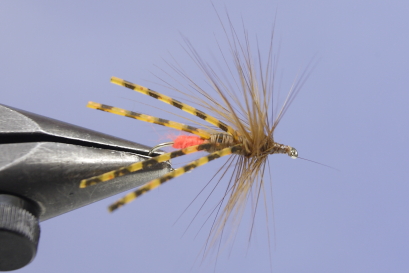
This is not an accepted fly pattern (none of the experts have devised it yet). Over the years the use of vibrating rubber legs has become popular with some anglers. The early flies used flexi floss which did the job but were not as good as the modern materials. Their success on the stillwaters for browns and rainbows led to the development of Sili legs and Micro Rubber legs which give a lot more life to the fly. Both of these are readily available in a range of different colours.
The method demonstrated I have found to be the simplest to tie to get the legs to sit well on the hook. The use of colours on the legs and bodies is only limited by your imagination. I do find a ‘hotspot’ at the tail helps.
- Hook Long shank lt. wt 10
- Thread Brown/black
- Hotspot Fluorescent orange/red/green floss
- Body 2 Strands of 4 ply nylon wool brown/black/olive
- Hackle Long fibre cock hackle brown/black/olive
- Legs Sili Legs/Micro Rubber colour to match body
Give this one a try and let me know how you get on !
Dave C and The Team
{ 20 comments… read them below or add one }
Next Comments →
Hello again Dave, a wee bit of help is needed, you mentoined henny cock capes, who are hey made from and where can I get them, if I go onto Google and type in “Henny Cock capes” it comes up with loads of forum pages about people asking for Henny cock capes, so maybe you could give me a link or a type/website to help find the hackle, thanks.
Thanks a lot. I am a subscriber to FF&FT, my for name is Profly99. You are an amazing tyer and teacher,I also watch Davie Mcphhail but he’s a wee bit quick for me, but I think he is still really good, I’m glad I found your tying, you’re the master and thanks for the kind comments
Hi Calum
Thanks for your e-mails……my Mum was born in Dumbarton! so I have an affinity for Scotland.
Impressed to read that you were confident at your age to try and get into the Scottish youth team. You have plenty of time to gain experience, just keep on fishing and be patient.
Hackles for palmering . I use henny cock capes……cheap to buy and give more movement to the fly.
Dubbing. I use antron mostly for lures because they are available in many colours. For wets and nymphs I prefer natural materials…..dyed rabbit, and my favourite in natural off the skin opposum, easy to dub and looks right.
Fly patterns are a different ‘can of worms’. There are so many fly tying pattern books available and as a cynic I think most of them are just variants on a theme……..many many ‘one day wonders’.
If your pocket money stretches to it subscribe to either ‘ Total Flyfisher’ or ‘Fly Fishing and Fly Tying’. Both are monthly, very good and informative.
Competition Flies are not my forte.
Wet Flies and nymphs. Greenwells, Hares Ear and montana both with or without gold bead, snipe and purple, partridge and orange,black spider,diawl bach.
Flytying Books ‘Fly Patterns’ by Taff Price****. and Bob Church’s Guide to the Champions Fly Patterns *** probably more suitable if you only do stillwater fishing.
Hope this helps. Always available to help.
Happy Fishing
DaveC.and the Team
Hi Mr Cammiss, you have helped my tying immensly, I’m 11 years old and fished to try to get into the Scottish Youth Team, unfortun ately I didn’t get in, at that time I wasn’t tying but now I’ve started it’s brilliant, thanks Mr Cammiss and please..please make more! One request though, could you maybe tie some more Irish and Scottish style wet flies as well as a few “competition” lures, thanks!
Hi Alan Beadell
I hope you are recovering well. Tying is a welcome form of therapy for me too as I recover from serious heart problems that I have been fighting for 30 years and coming through with the help of this hobby. I had read many books but Dave Cammiss really puts it all together in a simple way. Good luck to you all and as they say “tight lines”.
Hi james
I imagine that you are confused by the DaveC ? Just my funny way of signing off…… for Dave Cammiss……….now there is a name to work on!
Regards
DaveC. and the Team
hi ,is that your first or last name, doing family tree slowly??
Hi Alan Beadell,
Great to hear your comming through! I also enjoy Davie McPhail on youtube, he is another great instructor! Nice video Dave! 🙂
Hi Dave, Great hopper fly those rubberlegs are great, I’ve been reading some of your visitors comments and it seems most of us have something in common, since February 2008 i’ve been fighting cancer they took a cricket ball sized tumour out of my bowel and i ended up with a colostomy, then in 2009 it spread to my liver that operation they removed half of my liver which has since grown back and at last i think i can see light at the end of the tunnel, i started fly tying to keep my mind busy and i find your videos and a tyer in Scotland named Davie McPhail an inspiration, and i get great satisfaction when tying, your ideas seem quite simple when you explain them and it makes everything seem clear and easier please keep the videos coming as many of us beginners depend on them to keep us sane. I’m sorry to hear that you haven’t been well heres to a speedy recovery and thanks from everyone who watches your videos, to you and the team.
Regards Alan
Dave: I just found this site and I’ve been watching videos all evening. To say I am impressed is an understatement my friend. You are a consumate instructor. I am a disabled veteran – and fly tying and fishing are a form of therapy for me. Thanks to you and all the team members!
Hi david we are looking at giving children some free fishing training both course and fly. Can you tell me hiw i can get copies of your tiying vidios to use in some lessons? if possible for minimal cash?
yours
mick johnson
tel 01922713847
Hi Jonathan
Thanks for your e-mail. I know exactly how you feel! I went for a routine op on my varicose veins…ECG and it was cancelled. Now virtually living at QMC. Nottingham with warfarin to thin my blood, weekly blood test, mask at night for sleep apneia, and will eventually have an op. on my heart.
I suppose it must be better than a wooden box.
Hope you get sorted soon.
DaveC. and the Team
thankyou for a great site. I intended to start fly-fishing this seaason (gear preped and ready to go) but ended up having surgery instead, not good swap in my oppinion. So doing a lot more tying than fishing, your instruction is easy to follow and has got me through the early stages with very little fuss thankyou again.
Jonathan
fascinating video thankyou for providing such an enjoyable bit of film
Hi Mikko
Thanks for your comments on the vibrating daddy.
Ref. the Klinkhammer if you browse thro the intermediate lessons you will find it on lesson 3.
Happy fishing
DaveC.and the Team.
Great job on this daddy dave! The video was awesme! I think I’ll tie one as soon as I get some dry fly hooks and those rubber legs.
Ps. Could you make a video of tying a Klinkhammer?
Regards
Mikko
I find you site GREAT. Good information and vedio’s. Thank you
a pheasent tail nyph works good at being a mayfly in its young stage
About those rubber legs. I bought this transparent rubber-like “line”(?) little girls make necklaces from. It cost me next to nothing and is quite durable, even in salt water, yet not as flexible as those sili-legs you’ve shown us. Once the fly is tied (I mostly use them for shrimp imitations) I add black spots to them with a pen, and it looks quite “alive” actually. Now I wonder if anyone have tried regular rubberbands, like the ones we are rubbed in the face everytime we buy something from the butcher’s? That would be nice and cheap. Here in Denmark those “commercial” products cost half your life savings, so I’m allways looking out for alternative materials.
Thanks for the tutorials Dave. I love the way you say “happy fishing”. Especially this time ;o)
i looks hard but it is not